
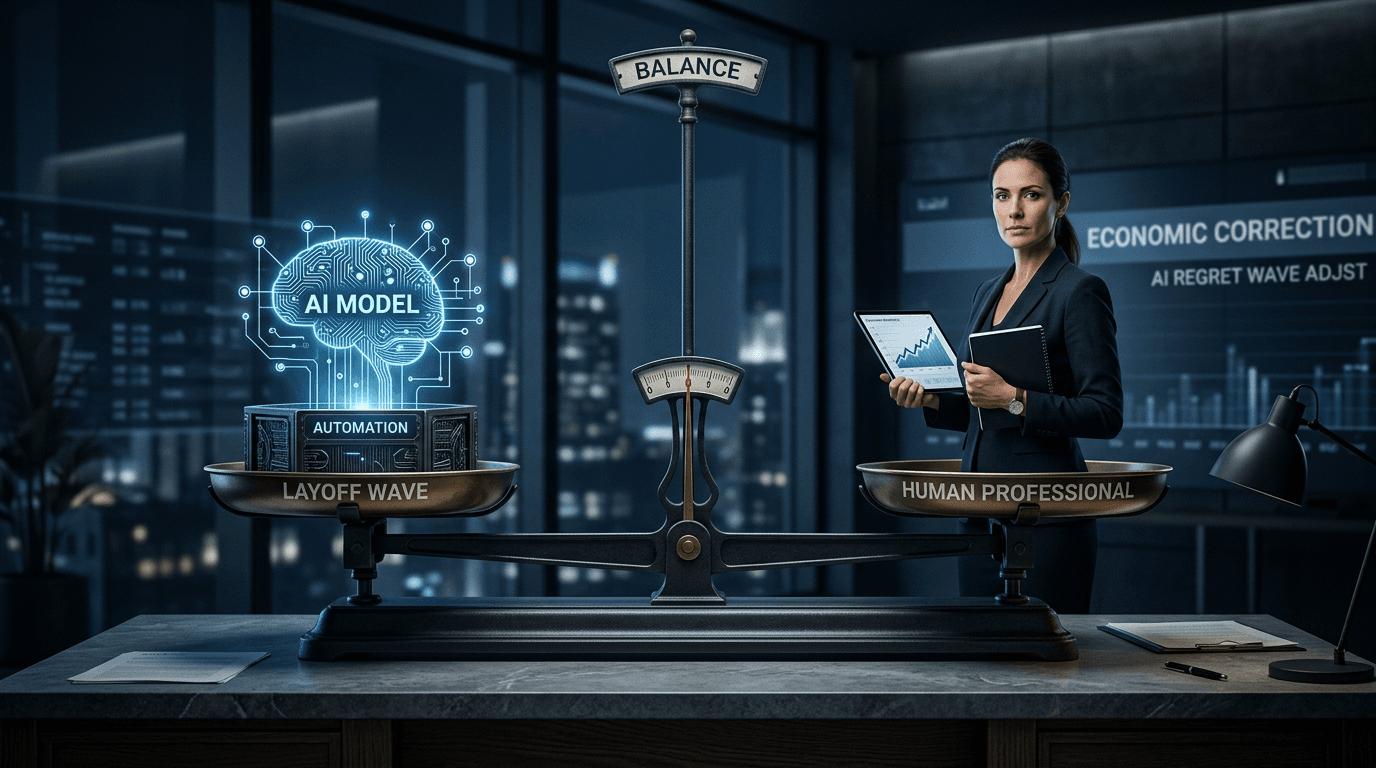
We are currently witnessing the first major "regret wave" of the AI era.
As of early July 2026, the data is coming in, and it is stark. A recent survey of "firing managers"—those who executed mass layoffs of engineers, customer service representatives, and white-collar professionals in late 2025 and early 2026—revealed that 55% now regret those decisions. Many organizations are quietly attempting to rehire the very staff they let go, often finding that the bridge has been burned and the talent has moved on.
The failure of the "AI replacement" strategy isn't just a failure of technology; it's a failure of arithmetic. Specifically, it is a failure to understand the difference between the 2024-2025 "one prompt" SaaS model and the 2026 "agentic" reality.
The 40% Failure Rate: The Sparse Data Trap
The initial justification for these layoffs was based on a simple observation: AI could resolve issues and fix code. And it could—60% of the time.
The problem is the other 40%.
AI models are trained on precedents. They excel at tasks for which there is a massive corpus of existing data. However, 40% of the issues encountered in a mature enterprise are novel, sparse, or specific to the unique context of that organization. In these cases, inference cannot generate a correct answer because the training data doesn't contain it.
This is where the "lost domain knowledge" hits hardest. For senior engineers, deep systems knowledge was never written down; it existed only in their experience. When you fire the engineer and replace them with a model, you haven't just replaced a worker—you've deleted the only repository of the "why" behind your architecture. When the AI fails on a novel 40% edge case, there is no one left who remembers why the system was built that way in 2018.
The Agent Cost Mismatch: The $500,000 Bill
The second factor driving the regret wave is the destruction of opex budgets.
Most companies justified layoffs using a cost model inherited from 2024: "one prompt, one response, one credit." They assumed that replacing a human salary with an AI license was a straightforward 10:1 cost reduction.
But AI agents don't work like 2024 chat interfaces. AI agents work and rework prompts in pursuit of a goal. They iterate. They reflect. They use tools. They call other models. In effect, a single high-level goal given to an agent can burn through a massive number of credits in minutes as it pursues success.
I heard an anecdote recently about a CTO who opened their monthly AI bill to find a $0.5M charge. The cause? They had given their remaining engineers "unlimited" AI licenses to boost productivity. While the engineers were indeed far more effective, the lack of cost controls in a SaaS-based agentic model destroyed the entire quarter's opex budget in thirty days.
Sovereign AI: Capping Opex with Capex
This is why Sovereign AI is not just about privacy or IP protection; it is about economic sanity.
The SaaS model for AI is currently designed for extraction, not enablement. Originally, SaaS was supposed to cost about 10% of what it would cost a consumer to provide the infrastructure for themselves. In AI, that ratio has inverted. The markup on token-based SaaS is now so high that the numbers no longer make sense for a CTO.
Sovereign AI—running open-weight models on bare metal hardware you own—eliminates the budgetary unpredictability of the "credit" model. It replaces an uncapped, extractive opex liability with a capped, predictable capex investment.
By physically capping your AI infrastructure, you place a hard ceiling on your opex. You decide how much productivity you are willing to pay for and at what rate. If your cluster is at capacity, the agents slow down; they don't bankrupt the company.
The Economic Correction
The original 10% SaaS promise was about sharing the burden of infrastructure. But when the provider's model is to charge you for every iterative "thought" an agent has, they are no longer a partner in your efficiency—they are a tax on your progress.
Governed cloud access is a step in the right direction for many, but the real economic shift happens when you move to the Sovereign Stack. Using AMD hardware and Kubernetes to orchestrate your own inference (what we do with Kaigents and KaiManager) isn't just a technical preference. It is the only way to ensure that the 40% failure rate doesn't come with a 400% budget overrun.
The regret wave of 2026 is a signal that the SaaS-only AI era is hitting its economic limit. The correction is sovereign infrastructure.