
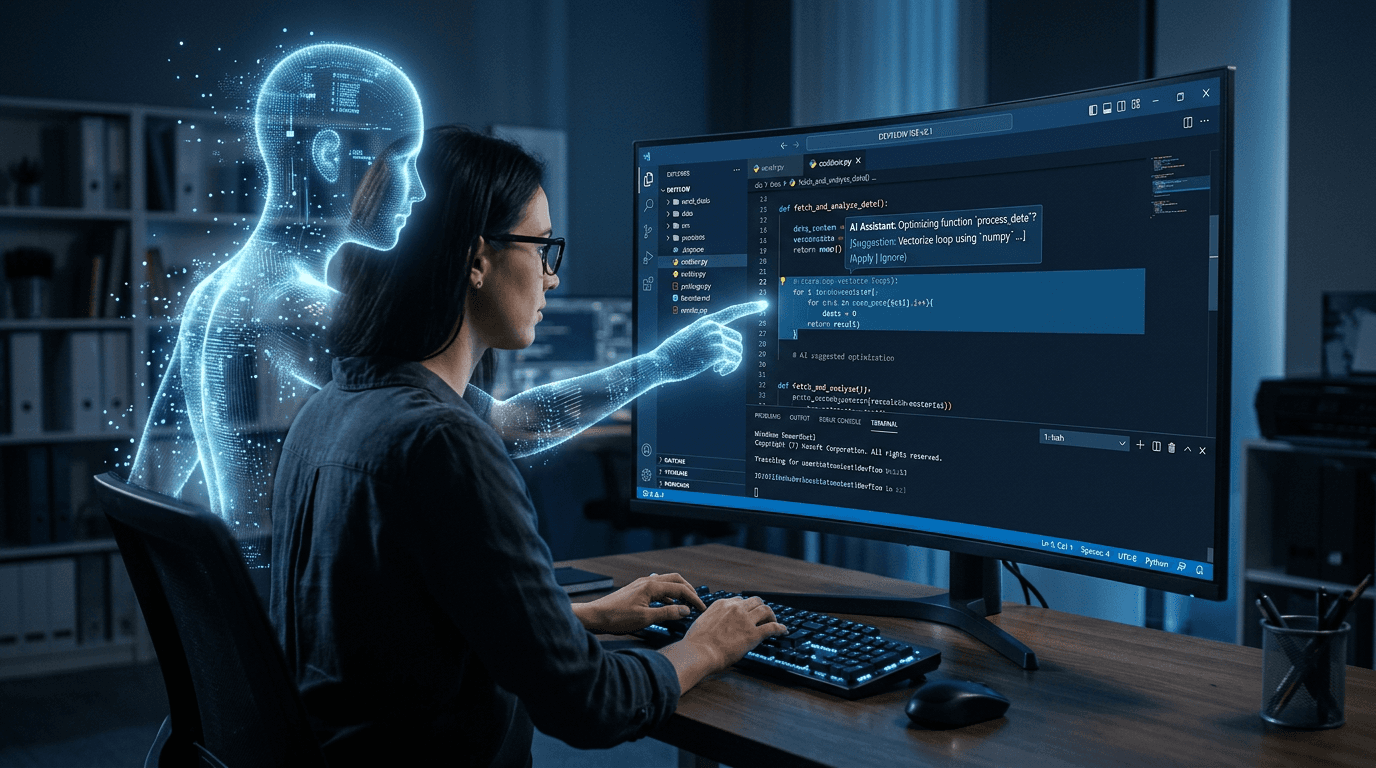
As February 2026 draws to a close, I’ve spent the last 28 days in a unique collaboration. My primary "pair programmer" hasn't been a human colleague, but a suite of autonomous AI agents—specifically Zencoder.ai and the integrated coding agents in my IDE.
Having spent over 40 years in software engineering—from the era of IBM mainframes to the birth of the cloud—I’ve seen dozens of "revolutionary" shifts. This one is different.
What Changes: The Velocity of Execution
The most jarring change is the collapse of the time between "Idea" and "Implementation." In the past, building a production-ready blog with MDX support, Mermaid diagrams, and a full content strategy would have been a two-week project for a solo developer.
With an autonomous agent:
- Scaffolding happens in seconds.
- Refactoring entire directories is a single command.
- Debugging is no longer about finding the needle in the haystack; it’s about explaining the haystack to a reasoning engine that already found the needle.
I no longer spend my time typing. I spend my time deciding.
What Absolutely Doesn't: The Principles of Engineering
There is a dangerous myth that AI makes "boring" engineering practices obsolete. In my experience this month, the opposite is true. The more autonomous the agent, the more rigorous the human must be.
If you hand an AI agent a vague request, it will give you a technically correct but strategically useless result. The things that haven't changed in 40 years are:
- The PRD (Product Requirements Document): You must know what you are building and why.
- The Technical Design: Architecture still matters. A "Majestic Monolith" is still usually better for a startup than a messy swarm of microservices.
- The Implementation Plan: You cannot skip steps. You still need a sequence of operations that respects dependencies.
- Quality Standards: "Done" still means tested, linted, and documented.
The Shift to Venture Architecture
The term I’ve landed on this month is Venture Architect.
In the old world, the Senior Engineer was a craftsman. In the new world, the Senior Engineer is a Governor. I am not writing the code; I am governing the process that produces the code. I am setting the quality gates, defining the behavioral boundaries, and ensuring that the output aligns with the business goal.
The Verdict
Working with an agent like Zencoder doesn't replace me. It removes the "friction of the keyboard." It allows me to stay in the "Strategy" layer of my brain for 90% of the day, rather than getting bogged down in syntax.
But let’s be clear: Without the 40 years of knowing where the "bodies are buried" in a Kubernetes cluster or why a Salesforce implementation fails, I would just be generating faster, more expensive technical debt.
The future of engineering is a partnership: The AI provides the speed; the Human provides the soul and the guardrails.
John K. Johansen is a Venture Architect and Founder of Kaigents. He leverages 40+ years of engineering leadership to build the next generation of autonomous enterprise teams.