
DeepSeek released V4-Pro-DSpark under the MIT license, and the AI infrastructure community greeted it with enthusiasm that was partially warranted and partially the result of not reading past the headline numbers.
The model is genuinely impressive. A 1.6 trillion parameter Mixture of Experts architecture with MIT licensing represents a meaningful contribution to the open-weight ecosystem — the kind of release that, eighteen months ago, would have seemed implausible from a Chinese AI lab. The DSpark speculative decoding system and its companion DeepSpec static draft spec are real engineering achievements that deliver measurable throughput improvements under the right conditions.
The problem is the gap between "the right conditions" and "the conditions most sovereign inference operators are running." That gap is large, it is technically specific, and it matters before you reorganize your inference strategy around DSpark's benchmark numbers.
What DSpark Actually Is
Speculative decoding is an inference acceleration technique that uses a small, fast draft model to speculatively generate candidate tokens, which a larger target model then verifies in parallel. When the draft model's predictions are correct — which happens at rates that vary significantly by model and task type — the throughput improvement is substantial, because verification is cheaper than generation. When the draft model's predictions are wrong, the speculative tokens are discarded and the target model generates normally. The net effect is throughput improvement proportional to the draft model's accuracy on your specific workload.
DSpark is DeepSeek's implementation of speculative decoding specifically optimized for the V4-Pro architecture. DeepSpec is the static draft specification — a pre-trained draft model designed to predict V4-Pro's token distribution with high accuracy. Together, they form a speculative decoding system that achieves meaningful throughput improvements when the underlying conditions support it.
The headline throughput numbers from DeepSeek's benchmarks come from specific hardware and model configurations. Understanding those conditions is the prerequisite for understanding what DSpark actually delivers on your infrastructure.
Condition One: The Hardware Requirement
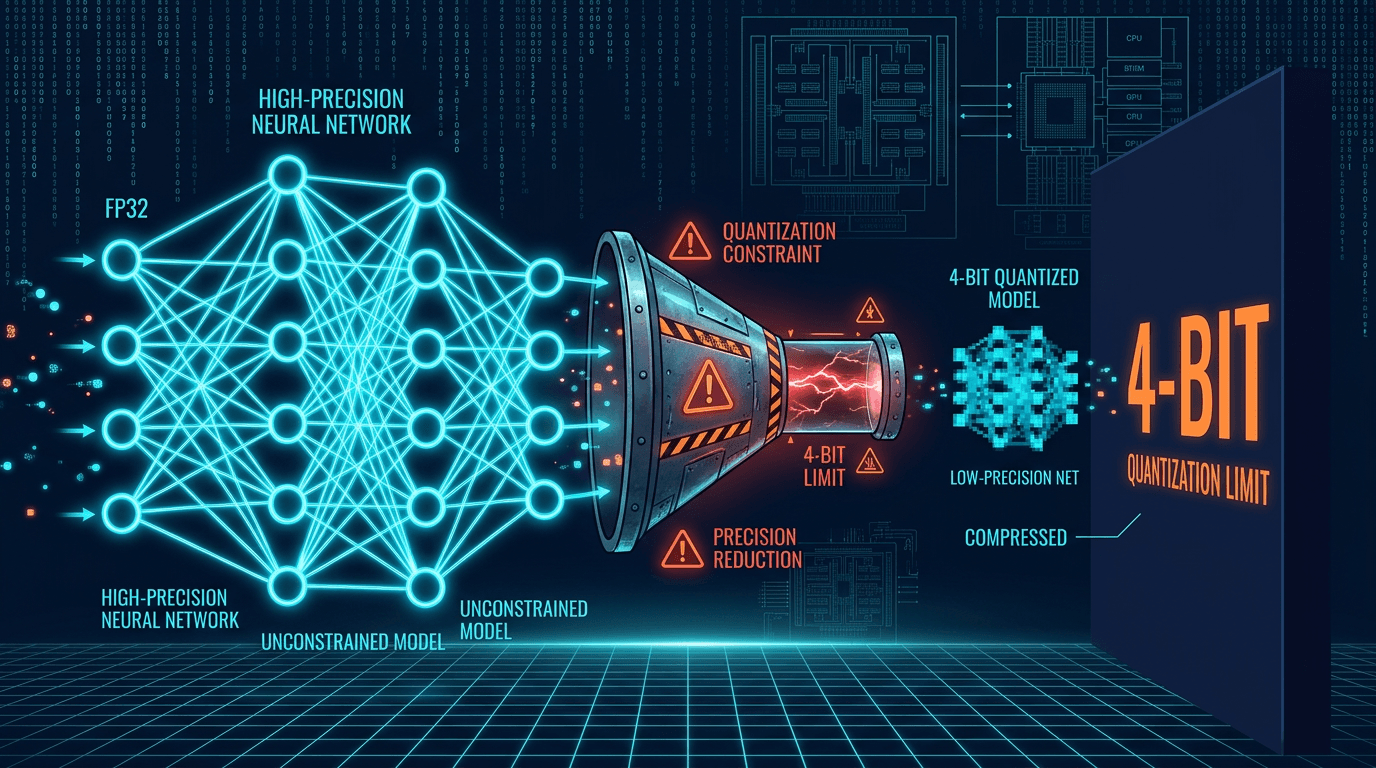
DeepSeek V4-Pro uses FP4 quantization via Quantization-Aware Training (QAT). This is not a standard post-training quantization approach — FP4 QAT trains the model with quantization in the loop, producing weights that are specifically optimized for FP4 execution rather than being retrofitted to it after training on a higher-precision objective.
The practical implication: FP4 execution requires hardware that has native FP4 support in its compute units. In the current hardware landscape, that means NVIDIA Blackwell architecture — specifically the B200 — which introduced hardware FP4 matrix multiply units as a first-class compute primitive. On Blackwell hardware with the NVFP4 kernel, V4-Pro's QAT weights run with the efficiency the benchmark was measured on.
On non-Blackwell hardware — which is most sovereign inference infrastructure, including AMD Ryzen AI, older NVIDIA architectures, and any CPU-based deployment — FP4 execution is not natively supported. The runtime either falls back to FP8 or FP16 execution (which works, but loses the efficiency gain of FP4), or fails with compatibility errors on kernels that require Blackwell-specific instructions. The NVFP4-optimized kernel implementations specifically target B200 architectures and will produce OOM errors or incompatibility failures on other hardware.
This is not a firmware version problem or a software update problem. It is a silicon generation problem. FP4 native execution on V4-Pro requires B200 hardware, and that hardware is not what most practitioners running sovereign inference stacks have available.
Condition Two: Speculative Decoding and the Quantized Draft Model Problem
The DSpark speculative decoding system achieves its throughput improvements under the assumption that the draft model can generate candidate tokens quickly enough and accurately enough to produce a net gain over non-speculative decoding.
On full-weight or lightly quantized FP8 models running on Blackwell hardware, this assumption holds. The draft model is fast, its prediction accuracy on V4-Pro's token distribution is sufficient, and the speculative decoding overhead is recovered in throughput.
On highly quantized models — the GGUF Q4 or Q5 quantizations that most sovereign inference operators use to fit large models into available VRAM — the math changes in two ways that compound each other.
First, aggressive quantization changes the model's token distribution. A Q4-quantized version of a model does not have the same probability mass distribution over the vocabulary as the full-weight version. The draft model was trained to predict the full-weight distribution. The mismatch between the draft model's predictions and the quantized target model's actual distribution reduces the acceptance rate of speculative tokens — meaning more speculative tokens are rejected, more fallback generation cycles occur, and the throughput gain shrinks toward zero or becomes negative.
Second, the quantized model is already faster than the full-weight model on commodity hardware, which changes the base case that speculative decoding is improving upon. The throughput gain from speculative decoding is largest when the target model is slow. When the target model is a Q4-quantized 7B running on a consumer GPU, it is already fast. The speculative decoding overhead — additional memory, additional computation for the draft model, coordination between draft and target — may exceed the gain from the reduced target model calls.
The result: on highly quantized models on non-Blackwell hardware, DSpark's throughput improvements are likely to be negligible or absent, and potentially negative depending on the specific quantization level and hardware configuration.
Condition Three: The Tokenization Incompatibility
DeepSeek V4-Pro requires specific tokenization helpers: encoding_dsv4 rather than the standard apply_chat_template interface that most inference stacks use. Standard chat templates are incompatible with V4-Pro's Think High and Think Max reasoning modes — using the standard template with these modes will produce tokenization failures that are not always obviously identified as tokenization problems in error logs.
For sovereign inference operators who have built inference pipelines around OpenAI-compatible APIs and standard tokenization interfaces, this introduces a compatibility requirement that is not trivially resolved. The inference server needs to implement V4-Pro-specific tokenization handling, which is not a standard feature of llama.cpp, Ollama, or the current Lemonade Server builds. Running V4-Pro correctly requires either a V4-Pro-aware inference stack or patching the tokenization path in whatever stack you are using.
What the Benchmark Numbers Represent
The published benchmark scores for V4-Pro-DSpark — including the LiveCodeBench and SWE-Verified numbers that have circulated in the coverage — are based on non-speculative, full-weight variants run in V4-Pro-Max configuration. These are not DSpark numbers. They are the performance ceiling of the underlying model without the speculative decoding optimization.
When you add DSpark on Blackwell B200 hardware with full-weight FP4 execution, you get throughput improvements on top of those numbers. When you add DSpark on quantized weights on non-Blackwell hardware, you get a configuration that the benchmark did not measure, and the performance characteristics will differ from the published numbers in ways that require your own evaluation to understand.
This is not a deceptive benchmark methodology — it is standard practice to benchmark models in their optimal configuration. The problem is that the optimal configuration and the typical sovereign inference configuration are separated by a generation of hardware and a quantization gulf.
What This Means for Your Inference Strategy
None of this should be read as "DeepSeek V4-Pro is not worth running." For organizations with Blackwell hardware or cloud access to B200-class inference, V4-Pro with DSpark is a legitimate option with meaningful performance characteristics. For the open-weight ecosystem broadly, the MIT license and the architectural innovation in V4-Pro are genuine contributions.
For sovereign inference operators running quantized models on AMD or older NVIDIA hardware — which is most of the homelab and small-enterprise sovereign stack community — the practical assessment is:
V4-Pro in its quantized form will run on your hardware, probably in Q4 or Q5 quantization via llama.cpp or Ollama once the tokenization compatibility is resolved. The performance will be the quantized performance, not the benchmark performance, and not the DSpark-enhanced performance. The model is capable. The speculative decoding acceleration is not what will reach you at Q4 quantization on gfx1150 or an RTX 4090.
For the sovereign inference workloads that fit the OGA hybrid pipeline — the 8B and smaller models I covered in the AMD hybrid execution article — the DeepSeek-R1-Distill variants (Llama-8B, Qwen-1.5B, Qwen-7B) are already in the Lemonade pre-quantized model catalog and run correctly through the hybrid stack. These are the DeepSeek models that are production-ready for your sovereign stack today, not V4-Pro-DSpark.
The benchmark is impressive. Know what conditions produced it before you plan around it.