
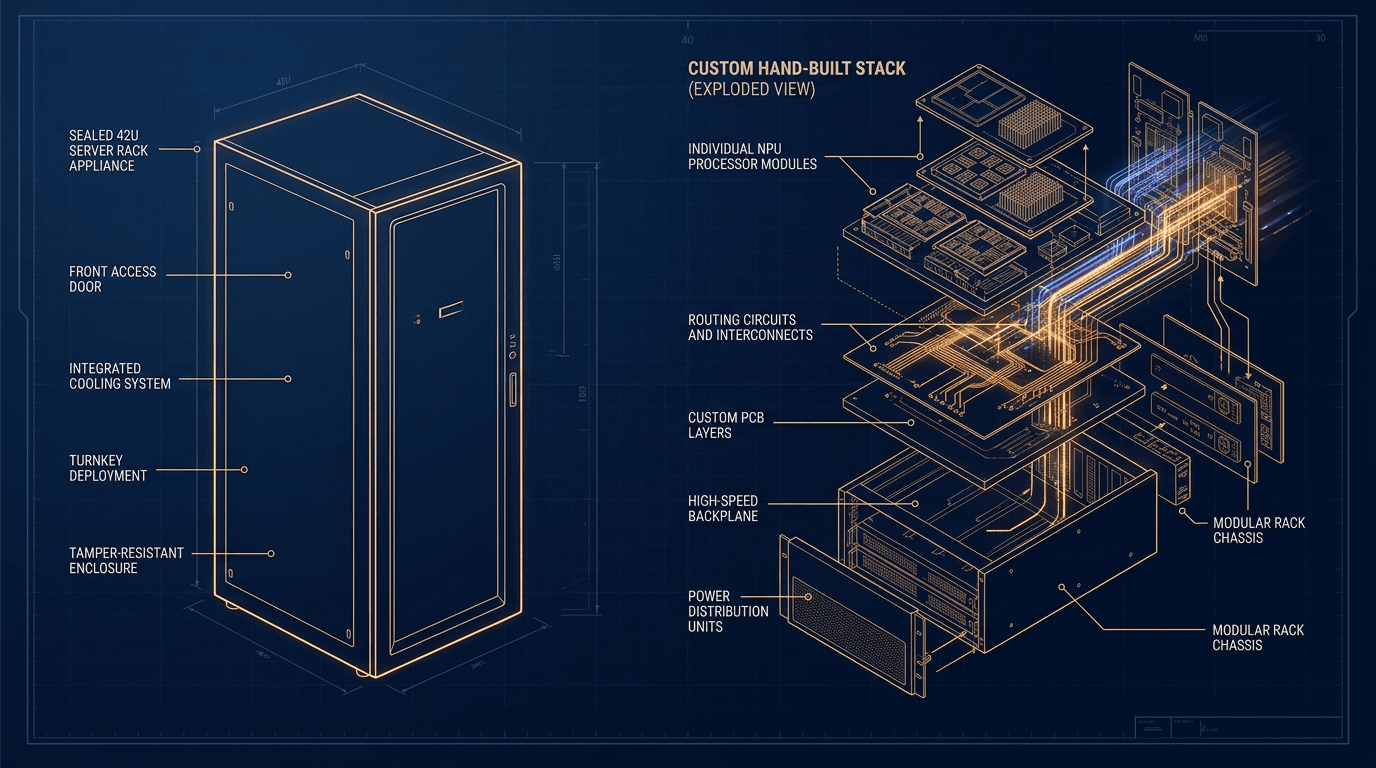
Three days ago, I watched a 42U server rack get wheeled into a highly restricted, network-separated financial facility, and it completely changed how I think about infrastructure. For years, the platform engineering community has operated under a shared delusion: we assumed that building "sovereign AI" meant compiling our own complex software stacks, tuning open-weight models on custom-built Kubernetes clusters, and writing complex Helm charts to glue together vLLM, Qdrant, and Prometheus. We treated sovereignty as an engineering architecture. But on August 19, 2026, South Korean telecom giant KT Corporation shattered that assumption by shipping the NPU LLM Station. It is a single, sealed, rack-mountable hardware appliance that runs fully offline with zero external cloud dependencies, combining Rebellions' ATOM-MAX Neural Processing Unit (NPU) with KT's proprietary 32-billion parameter Mi:dm K 2.5 Pro model.
This is not a development kit; it is a physical box that turns sovereignty into a straightforward procurement decision. For senior engineers who have spent the last eighteen months arguing that their bespoke, hand-built Kubernetes clusters are the only way to keep AI workloads secure, this appliance is a direct challenge. Your compliance officers and Chief Information Security Officers (CISOs) do not want to manage your open-source dependencies, security-patch your containers, or worry about whether your K8s ingress is leaking data. They want a single vendor to hold accountable, a sealed physical boundary, and an audit trail that can be verified during a walk-through of a network-separated site. The era of hand-assembling sovereign AI is ending, and we must adapt to the reality of the sealed appliance.
The Physical Reality of the Sealed Box
To understand why this is happening, we have to look at the massive gap between what platform engineers enjoy building and what regulated buyers actually want to operate. When I consult as a fractional CTO for financial institutions and defense contractors, the biggest friction point is never model accuracy or token throughput. It is the operational tax of the underlying infrastructure. A typical Kubernetes-based sovereign AI stack is a sprawling web of dependencies. You have a base OS, a container runtime, the Kubernetes control plane, GPU driver modules (often requiring proprietary Nvidia kernel modules that break with every minor kernel update), Triton Inference Server or vLLM, a vector database like pgvector or Qdrant, a gateway like LiteLLM for access control, and a monitoring stack built on Prometheus and Grafana.
Every single layer in that self-assembled stack represents a distinct point of failure and a massive surface area for security vulnerabilities. In my experience, a standard PyTorch-based inference container carries over three hundred known Common Vulnerabilities and Exposures (CVEs) in its base image on any given Tuesday. To a CISO, that self-assembled stack is a security nightmare. The KT NPU LLM Station solves this by boxing the entire software and hardware stack into a sealed hardware unit. According to the product release details published by RCR Wireless on August 20, 2026, the appliance requires zero external network connections and runs fully offline inside network-separated enterprise data centers.
It provides standard REST-style, OpenAI-compatible API endpoints directly out of the box. From the perspective of the network team, it is just another sealed server in the rack that accepts HTTPS traffic on port 443 and returns JSON. You do not need to configure complex Kubernetes network policies, you do not need to manage GPU memory allocation, and you do not need to worry about container runtime security. The vendor packages the firmware, the model weights, and the operating system into an immutable image. Sovereignty is no longer a complex software integration project; it is a hardware asset that you order via a standard purchase requisition form, install in a physical cabinet, and power on.
The Compliance Trap and the CISO's Signature
This shift from custom architecture to physical procurement is being accelerated by the tightening vise of global AI regulations. On August 2, 2026, the third wave of the European Union AI Act requirements officially took force. According to a detailed legal analysis published by Debevoise & Plimpton on August 3, 2026, general-purpose AI (GPAI) model obligations are now legally enforceable, Article 50 transparency duties apply, and national supervisory authorities have gained full inspection powers. This regulatory landscape has fundamentally altered the build-versus-buy calculus.
Under these new rules, maintaining a compliant AI infrastructure is no longer about having a written policy PDF or a vague promise of data privacy. As detailed in an on-premises governance study by SysArt Consulting, the EU AI Act legally mandates that high-risk systems maintain automatic event logs across the system's entire operational lifetime to guarantee traceability. If you run your own custom inference layer on a vanilla Kubernetes cluster, your platform team is fully responsible for engineering that audit trail. You must build, maintain, and guarantee the immutability of every single model decision log, user access prompt, and system response.
When a regulatory auditor walks into your office and demands to see the evidence chain for a specific model completion from three months ago, saying "it is somewhere in our Elasticsearch logs" will not suffice. A sealed appliance like the KT NPU LLM Station builds this audit trail directly into its firmware. The appliance manages the logging, the prompt-response archiving, and the user access control at the hardware-firmware boundary. For a CISO, signing off on a pre-certified, audited appliance with a single signature is infinitely safer than taking on the legal liability of a custom-built infrastructure stack. The appliance provides a clean separation of concerns: the platform team operates the network port, the compliance team audits the immutable logs, and the engineering team consumes the API.
Technical Anatomy of the Air-Gapped Appliance
Let us strip away the high-level compliance talk and look at what is actually inside this machine. The hardware is built around Rebellions' ATOM-MAX NPU, which represents a significant departure from the Nvidia-dominated GPU paradigm that most platform teams are locked into. According to technical specifications published by TechTimes on August 19, 2026, the ATOM-MAX chip delivers 128 teraflops of FP16 compute and 512 TOPS of INT8 precision. In certified performance testing, this architecture demonstrated substantially higher power efficiency than comparable mainstream GPUs for specific inference workloads.
From an engineering perspective, using an NPU instead of a GPU introduces a completely different execution model. Unlike a general-purpose GPU, which requires heavy software layers like CUDA to translate matrix multiplications, the NPU is a specialized ASIC designed purely for the data-flow patterns of neural networks. The software stack on the KT NPU LLM Station is optimized specifically for this silicon, bypassing the heavy overhead of the generic PyTorch runtime. It runs KT’s proprietary Mi:dm K 2.5 Pro model, which is a 32-billion parameter model tailored for enterprise workflows, particularly in the Korean language and regulated administrative sectors.
To interface with the appliance, you do not write custom Triton configuration files or manage vLLM execution arguments. Instead, the appliance exposes a simplified, hardened API platform that handles Document-to-Vector ingestion and Retrieval-Augmented Generation (RAG) out of the box. Let us look at how simple the integration is. Instead of deploying a vector database, an embedding model container, and an orchestration framework like LangChain, you interact with the appliance through a single, secure gateway. For example, initiating a secure, context-aware query against your localized document repository looks like this:
curl -X POST https://sovereign-ai-station.local/api/v1/chat/completions \
  -H "Authorization: Bearer s_ai_9f8e7d6c5b4" \
  -H "Content-Type: application/json" \
  -d '{
    "model": "midm-k-2.5-pro",
    "messages": [
      {"role": "user", "content": "Analyze the attached Q2 compliance ledger for unauthorized cross-border wire transfers."}
    ],
    "context_id": "compliance-ledger-q2-2026",
    "stream": false,
    "temperature": 0.0
  }'
The appliance handles the document segmentation, embedding generation, vector search, prompt construction, and NPU-accelerated inference entirely within its physical chassis. You do not manage any of the intermediate states, and you do not risk leaking data across container networks. The engineering effort shifts from managing complex distributed systems to writing clean, well-structured API integrations.
The Hidden Cost of Cognitive Lock-In
However, we must not let procurement convenience blind us to the severe architectural trade-offs of this appliance-based model. When you purchase a sealed sovereign AI appliance, you are trading operational simplicity for absolute vendor lock-in. A study published by IBM on June 17, 2026, titled "Limited Control and Rising Dependencies Leave Enterprises Exposed in the Age of AI," highlights that rising dependencies on closed-loop, integrated software-hardware stacks leave enterprise architectures highly exposed to long-term risk.
This is what industry analysts call "cognitive lock-in." In a traditional self-hosted Kubernetes stack, if a superior open-weight model is released tomorrow—such as a new Llama variant—you can pull the model weights, update your vLLM deployment configuration, and run the new model on your existing GPU or NPU hardware. If a cheaper hardware accelerator becomes available, you can swap your PCIe cards or provision a new node pool. You own the architectural choices.
With an appliance like the KT NPU LLM Station, those choices are made for you. You cannot swap out the Mi:dm K 2.5 Pro model for a Mistral or Llama model because the underlying compilation toolchain for the Rebellions NPU is closed and tuned specifically for KT's proprietary weights. You cannot upgrade the underlying silicon without replacing the entire physical unit. You are locked into KT's software update schedule, KT's security patching timeline, and KT's model development roadmap.
The Cloud Security Alliance (CSA) published a research note in April 2026 on "Sovereign AI Dependency: The Pentagon-Anthropic Concentration Trap" which outlines the severe risks of relying on a single, integrated vendor for sovereign operations. When an organization runs its critical business logic, proprietary knowledge bases, and decision engines on a closed, un-auditable platform, they create a systemic dependency. If the vendor increases their licensing fees, alters their model's behavior, or decides to discontinue support for that specific hardware revision, the enterprise has no graceful migration path. They must either pay the premium or rebuild their entire AI operational layer from scratch.
A Rational Decisional Framework for On-Premise AI
As a senior engineer or architect, you must look past the hype of both the "build everything on Kubernetes" purists and the "buy a sealed appliance" salespeople. You need a cold, mathematical framework to guide your infrastructure decisions. In my experience, the decision to build a self-hosted Kubernetes stack versus buying a pre-integrated appliance should be driven by three metrics: token volume, engineering resource cost, and the volatility of your model requirements.
First, look at the economic break-even point. According to the On-Premise LLM Deployment Guide published by LLM Configurator on July 1, 2026, the baseline financial break-even for self-hosting on-premises LLM inference is approximately 3 to 5 million tokens per month. If your organization consumes fewer tokens than this threshold, the hardware amortization and operational overhead of running your own servers make self-hosting a massive financial loss compared to managed cloud APIs.
However, if your compliance requirements mandate absolute physical isolation—forcing you on-premises regardless of volume—you must evaluate the total cost of ownership (TCO) including engineering labor. Running a custom, secure Kubernetes AI cluster requires at least 0.5 to 1.0 full-time equivalent (FTE) of a senior platform engineer's time solely dedicated to managing the GPU/NPU drivers, inference runtimes, and compliance logging pipelines. At typical 2026 compensation rates, that represents an operational overhead of $150,000 to $250,000 annually, before you spend a single dollar on server hardware.
Compare this to a competitor sovereign AI appliance like the ARSA Sovereign, which starts at $26,900 for a pre-configured unit (according to pricing published by ARSA Technology in 2026). If your organization has low to moderate volume but requires absolute physical isolation for regulatory compliance, the upfront capital expenditure of a sealed appliance is significantly lower than the ongoing operational labor cost of building and maintaining your own custom platform.
I use a simple decision matrix when advising founders and infrastructure teams on this choice:
- Choose a Sealed Sovereign Appliance (e.g., KT NPU LLM Station) if: Your primary driver is regulatory compliance (such as the EU AI Act or strict network-separation laws), you have a small platform engineering team that cannot dedicate a full FTE to LLM infrastructure, your model requirements are stable, and you are comfortable with vendor-managed software lifecycles.
- Choose a Custom Kubernetes-Native Stack (e.g., vLLM on K8s) if: You have a mature platform engineering team already running production Kubernetes, your applications require frequent model swapping or fine-tuning, your token volume is extremely high (exceeding 20 million tokens per day), and you must avoid any form of hardware or software lock-in.
A hybrid routing pattern is also emerging as the most practical compromise for mid-sized enterprises. Under this model, you route your high-volume, standard utility queries to a highly efficient, sealed on-premise appliance, while routing your complex, highly customized, or rapidly evolving workloads to a smaller, highly flexible self-hosted cluster where your engineering team can experiment with the latest open-source models. This keeps your compliance and operational tax low while preserving your long-term architectural optionality.
The Actionable Next Step
Stop treating the sovereign AI debate as a purely theoretical discussion about software architectures, and start evaluating the physical operational costs of your compliance requirements. Your next step is to audit your organization's actual engineering capacity and compliance overhead. Document the exact number of hours your team currently spends managing base OS images, container CVEs, and inference runtime updates. Present this TCO calculation to your CISO alongside the pricing for a sealed sovereign appliance, and force a rational, financial decision between the operational cost of custom-assembled infrastructure and the lock-in risk of a pre-certified hardware box.
Sources
- https://rcrwireless.com/20260820/ai/kt-npu-llm-station
- https://www.koreatimes.co.kr/business/companies/20260819/kt-puts-korean-ai-chips-language-model-into-one-enterprise-server
- https://www.techtimes.com/articles/324976/20260819/koreas-first-sovereign-ai-appliance-ships-domestic-chip-domestic-llm-one-server.htm
- https://www.debevoisedatablog.com/2026/08/03/the-third-wave-of-eu-ai-act-requirements-are-in-force-transparency-requirements-supervisory-powers/
- https://sysart.consulting/insights/general-purpose-ai-model-obligations-on-premises-governance/
- https://newsroom.ibm.com/2026-06-17-ibm-study-limited-control-and-rising-dependencies-leave-enterprises-exposed-in-the-age-of-ai
- https://labs.cloudsecurityalliance.org/wp-content/uploads/2026/04/CSA_research_note_sovereign_ai_vendor_dependency_dod_anthropic_20260413-csa-styled.pdf
- https://llmconfigurator.com/en/enterprise/on-premise-llm-deployment
- https://arsa.technology/products/sovereign/