
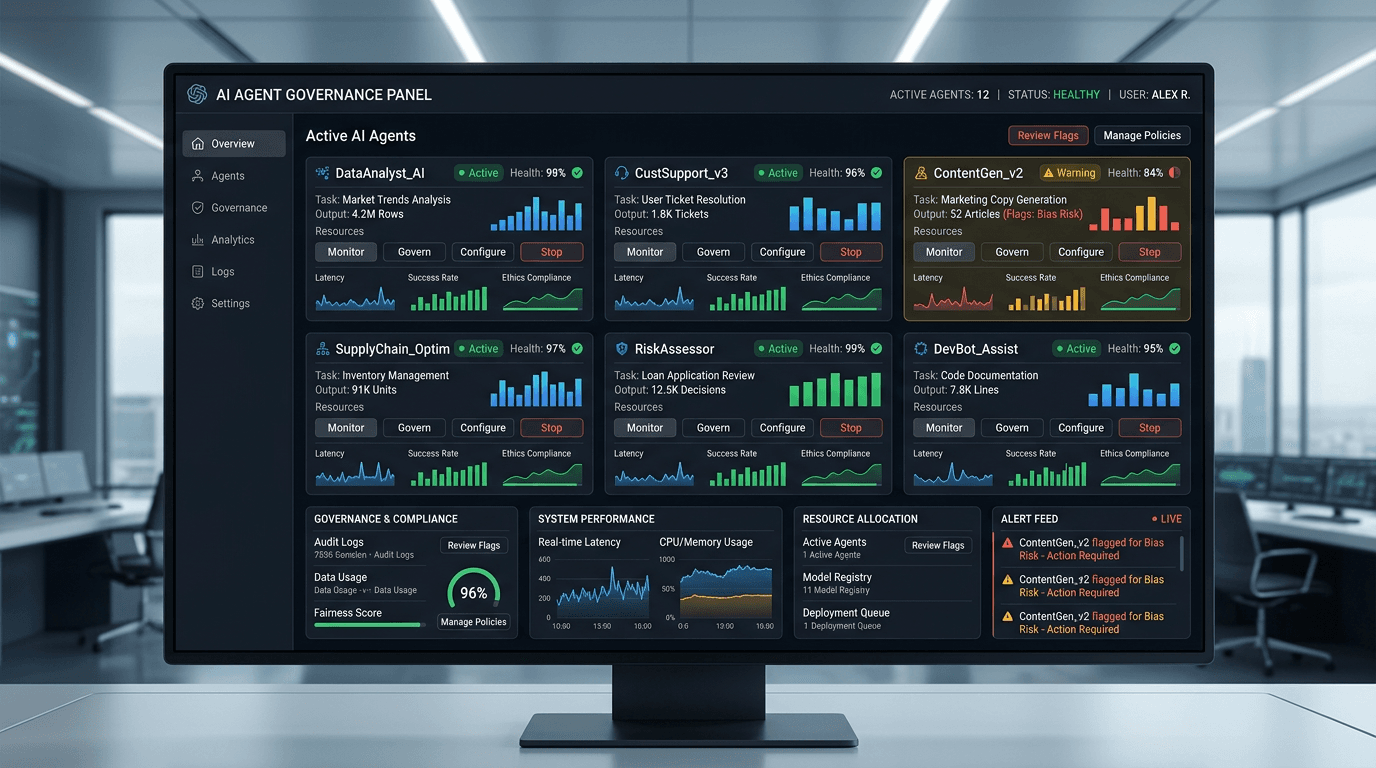
I have been writing about the missing management layer in enterprise AI since I started building Kaigents in 2024. The argument is straightforward: AI agents are the most powerful autonomous systems most organizations have ever deployed, and they are being deployed without the governance infrastructure that any other autonomous system would require. The fix is not better models or better prompts. It is a management layer — a system that sits above the agents and governs what they can do, what they are doing, and what they did.
In late June 2026, two significant open-source projects shipped that validate this exactly: Databricks open-sourced Omnigent, a meta-harness that sits above existing agent frameworks to centralize cost controls, security sandboxing, and policy enforcement. ValidMind launched Atryum, an open-source governance layer that intercepts agent tool calls and evaluates them against policy. Different companies, different approaches, the same gap.
When the market converges on the same architectural pattern from multiple directions, it has arrived at a conclusion. The management layer conclusion arrived this week.
The Permission vs. Policy Distinction
The most important concept in the Atryum announcement is one that did not get enough attention in the coverage: the difference between permission-based and policy-based agent governance.
Permission-based governance is what most enterprise AI deployments have today. The agent can access tool X or it cannot. The access control list determines what is possible. This is the traditional approach imported from application security — define what each principal can do, enforce those definitions at the authentication layer.
Policy-based governance asks a different question. Even if the agent has permission to do X, should it do X right now, given the current context, the current state of the workflow, and the current risk environment?
An agent that has permission to send an email should not send an email containing proprietary financial data to an external address, even if the agent technically has permission to access the email tool and technically has access to the financial data. The permission model cannot catch this. Only a policy model can — one that evaluates the action against a richer set of governance rules that understand what the agent is doing, not just whether it is allowed to do it.
Atryum intercepts tool calls and evaluates them against policy before they execute. This is architecturally more powerful than any permission list. It is also harder to implement correctly, which is why it did not exist as an open-source primitive until now.
What Omnigent Solves
Databricks built Omnigent to address a different but related problem: the multi-framework enterprise AI environment.
Most organizations that have been building AI capabilities for more than a year have an embarrassing diversity problem. Team A built their first agent in LangChain because that was the mature option in 2024. Team B used CrewAI for their multi-agent experiment. Team C has a custom Claude integration built before any of the frameworks existed. Team D is running Kaigents. Each framework has its own auth model, its own logging format, its own cost accounting, its own security sandbox. The CISO cannot see across all of them. The finance team cannot aggregate costs across all of them. The security team cannot enforce consistent policy across all of them.
Omnigent is a meta-harness: a layer that sits above all of these frameworks and provides a unified surface for cost controls, security sandboxing, and policy enforcement — regardless of which underlying framework generated the agent traffic. The agent frameworks run as they always have. Omnigent intercepts at a level above them, normalizes the observable surface, and applies enterprise governance.
This is the architectural pattern I have been calling the "management layer" — not a replacement for agent frameworks, but a governor above them. Omnigent's open-source release validates that this pattern is real, necessary, and implementable.
The Convergence Signal
When Databricks (a data platform company whose core business is enterprise data infrastructure) and ValidMind (a model risk company whose core business is AI governance in regulated industries) both ship governance layers for agent orchestration in the same week, they are not copying each other. They are independently arriving at the same conclusion from different starting points.
Databricks is coming from the data platform perspective: their customers run complex data workflows and now want agent orchestration integrated into those workflows with the same governance they apply to everything else. ValidMind is coming from the model risk perspective: their customers are regulated institutions for whom any automated decision-making system requires audit trails, policy enforcement, and oversight mechanisms.
The fact that both companies arrive at "a governance layer above the agent framework" as the solution means that solution is correct across different contexts and different customer types. It is not a niche answer. It is the general answer.
How This Maps to Kaigents
I have been building the management layer for Kaigents for two years. KaiManager provides process governance — workflow definitions, state management, quality gates, and audit trails for multi-agent processes. KaiCatalog provides tool governance — a curated registry of approved MCP servers with structured metadata and access policies. Together, they provide the same architectural pattern that Omnigent and Atryum are now delivering as open-source primitives.
The difference is integration: Kaigents is a full platform where the management layer is built in from the beginning, rather than layered on top of existing frameworks. The advantage of the Kaigents approach is that governance is not an afterthought — it is not possible to build a Kaigents workflow without audit trails and quality gates, because they are structural. The advantage of the Omnigent/Atryum approach is that they can be applied to existing deployments without migrating to a new platform.
Both are valid. The market needs both. I am glad the ecosystem is maturing.
The Organizational Question
The technical question — which management layer to use — is now answerable. Omnigent, Atryum, and Kaigents all provide real governance infrastructure for agent deployments. The harder question is organizational: who owns the management layer in your organization, and how does it connect to your existing risk management and compliance infrastructure?
In most organizations, this question has not been answered. The AI team built the agents. The security team reviewed the infrastructure. Nobody owns the runtime governance. The management layer tools exist; the organizational home for running them does not.
That organizational gap is the next thing that needs to close. The tools are ready. The question is whether the governance function — the human team responsible for defining and enforcing the policies that Atryum and Omnigent will execute — exists yet in your organization.
If it does not, now is the time to build it. The tools are waiting.