
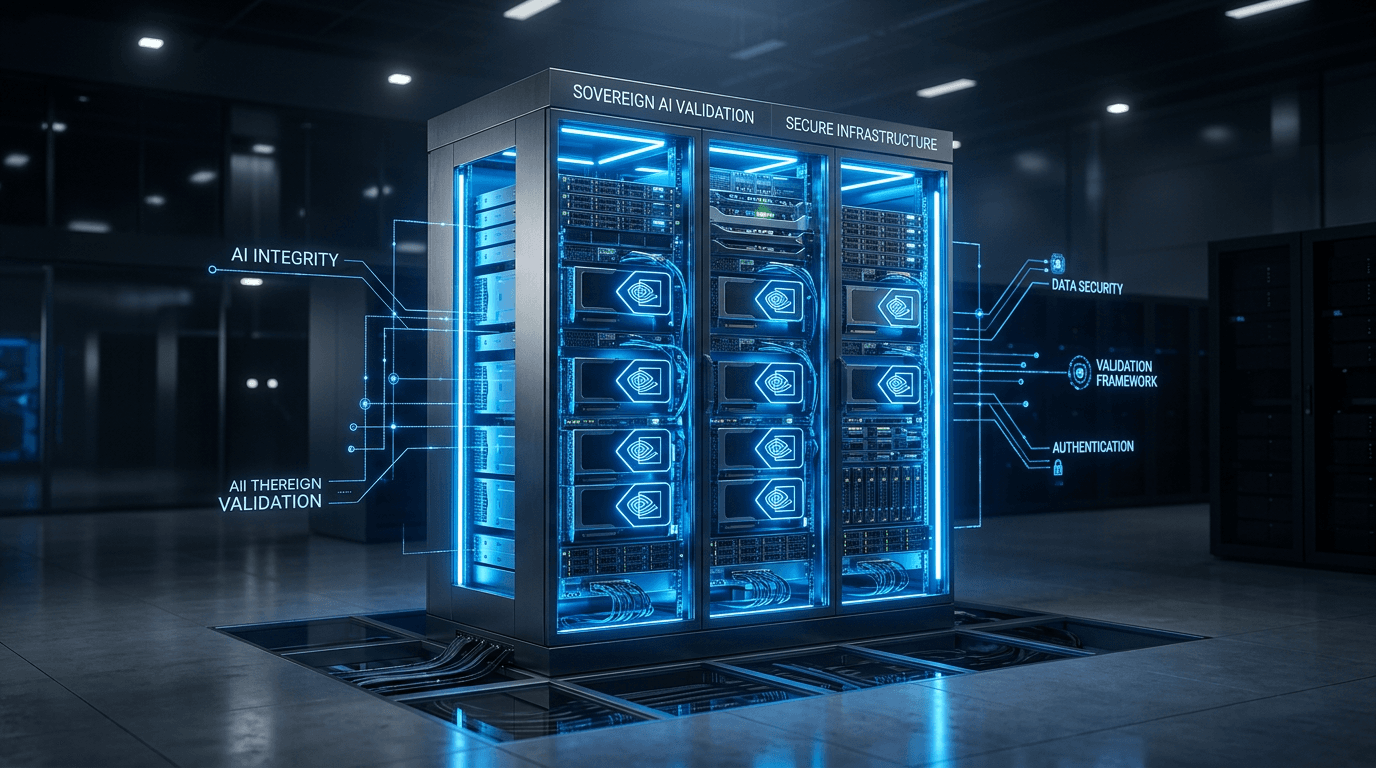
In early 2025, I built a sovereign AI homelab on AMD Ryzen AI hardware. Local inference on hardware I controlled, no data leaving my perimeter, model weights I owned. At the time, the reaction from many quarters was polite skepticism. Why would you do that when the cloud APIs are so capable and so cheap? You are solving a problem most enterprises don't have.
On June 29, 2026, Palantir and Nvidia launched a joint engine to run Nemotron open-weight models in air-gapped, classified government environments. Customers own the model weights outright. The deployment runs entirely within infrastructure the customer controls. No data leaves. No inference happens on third-party silicon.
That is the sovereign AI thesis made into a product, shipped by two of the most credibility-rich names in enterprise AI. I am not surprised. But I am glad the conversation can move forward now.
What the Palantir/Nvidia Announcement Actually Says
The Palantir/Nvidia engine is not primarily a technology announcement. The technology — running open-weight models on-premise with GPU acceleration — has been available for some time. What the announcement says is that the market for air-gapped sovereign AI is large enough, and credible enough, that Palantir and Nvidia have jointly prioritized it.
Palantir has built its enterprise business on the premise that serious organizations — governments, defense contractors, regulated industries — require complete control over their data and the systems that process it. Nvidia builds the hardware that those systems run on. When those two companies jointly ship a product positioned around air-gapped sovereignty, they are not making a technology bet. They are making a market bet. And their market bets are usually right.
The customer-owned model weights detail matters more than the air-gapped deployment detail. Running inference on your own hardware is infrastructure engineering. Owning the weights means that the intelligence embedded in those parameters — everything the model learned — is yours. You can fine-tune it on your proprietary data without that data leaving your environment. You can audit what it knows. You can delete it. That is a fundamentally different relationship with AI than the API model provides.
What Sovereign AI Actually Requires
The term "sovereign AI" has been stretched to cover a range of things that are not sovereign. Let me be precise about what I mean and what the Palantir/Nvidia product represents.
You own or control the model weights. This is the foundational requirement. If the model runs on your infrastructure but the weights belong to a vendor who can revoke access, modify them remotely, or audit what you've done with them, you don't have sovereignty. You have a managed service that happens to be on-premise. Sovereignty requires that the weights are yours — you can copy them, back them up, fine-tune them, and no third party can change that relationship.
Inference runs on hardware you control. The compute that processes your prompts and generates your responses must be on hardware you own or lease in an environment you control. Cloud inference APIs, however secure the provider claims to be, run on hardware you don't control. The provider's employees have physical access to that hardware. Their government's legal system has compelled access to it before. If the inference happens on your hardware, in your facility, neither of those things is true.
Derived intelligence stays in your perimeter. This is the least-discussed requirement and the most important for AI specifically. Your raw data may be properly protected. But the embeddings generated from that data — the vector representations of your proprietary documents, your customer interactions, your operational patterns — are derived intelligence. They encode things about your business that the raw data doesn't reveal directly. If those embeddings are generated on third-party infrastructure, you have exported intelligence about your business even if you never exported the underlying data.
The Palantir/Nvidia engine satisfies all three requirements for its target market. My AMD Kubernetes homelab satisfies all three at a fraction of the cost. The architecture is the same; the scale and the support model differ.
The Price Point Spectrum
The Palantir/Nvidia approach targets classified government and large enterprise. The economics of that market allow for the deployment and operational complexity that their solution requires. Not every organization needs to operate at that level.
For the Sovereign Stack I've been building and writing about — a bare-metal Kubernetes cluster running AMD Ryzen AI hardware, Lemonade Server for local inference, open-weight models from the Qwen and GPT-OSS families — the architecture achieves the same three requirements at startup-accessible economics. The AMD Ryzen AI Halo Developer Platform I wrote about in June starts at $4,000. A three-node cluster is under $15,000. That is not a classified government procurement; it is a startup infrastructure decision.
The point is not that every organization should build the same thing I built. The point is that the underlying architecture — own the weights, control the inference, keep the derived intelligence local — is sound across the entire price spectrum. Palantir and Nvidia are selling a supported, enterprise-grade implementation of it. The sovereign stack community has been building the accessible version for the past eighteen months.
What This Means for the Organizations Watching from the Sidelines
There is a category of enterprise AI decision that has been stalled for two years: organizations that recognize the data sovereignty argument but have been waiting for it to be validated by names they trust before committing to the architecture.
Palantir and Nvidia are those names. The announcement on June 29 is the validation those organizations have been waiting for.
The practical implication is that the air-gapped sovereign AI architecture — which looked experimental in 2024 and credible in early 2026 — is now enterprise-endorsed. Security and risk teams that have been skeptical of self-hosted AI proposals can now evaluate those proposals against a Palantir/Nvidia reference architecture rather than against a research paper.
The question for those organizations is no longer "is this approach legitimate?" It is "which implementation fits our budget, our team, and our threat model?" That is a much more tractable question. And it is one I am glad we can finally ask.
The Work Ahead
Sovereign AI is not a configuration; it is a practice. Owning the weights, controlling the inference, and keeping derived intelligence local are the architectural requirements. But they do not guarantee security by themselves. The operational discipline of managing model access, auditing inference logs, securing the hardware, and governing what prompts and data enter the system — that is the ongoing work.
The Palantir/Nvidia announcement gives the architecture legitimacy. My work with Kaigents is aimed at giving the operational discipline a toolset: process governance, audit trails, quality gates, tool allowlisting. The architecture and the governance layer together are what "sovereign AI in production" actually means.
The fringe position has become mainstream. The mainstream position is now about getting the implementation right.