
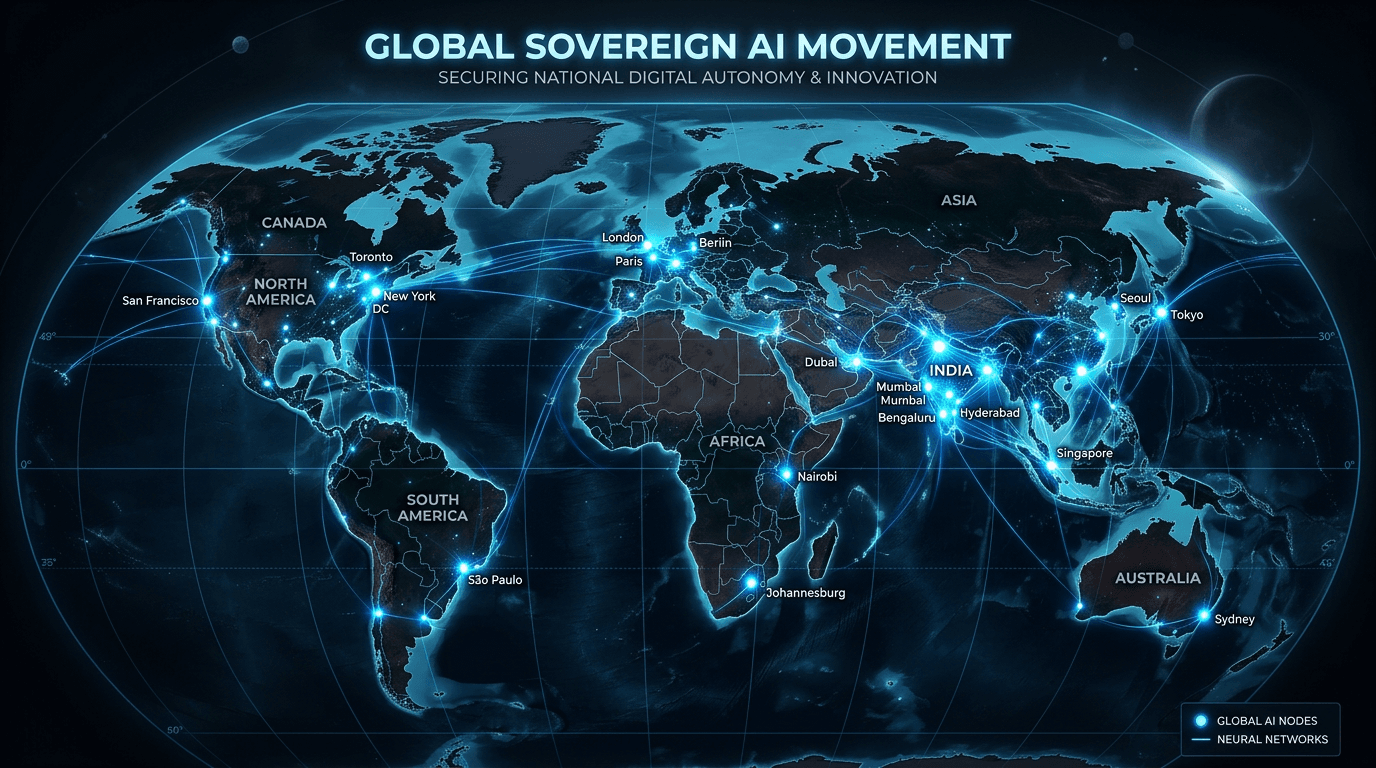
KubeCon India 2026 had a throughline that I did not expect when I first looked at the agenda: sovereignty. Not Kubernetes features, not cloud-native patterns, not the usual infrastructure evolution story. Sovereignty — where data lives, who controls it, and what architecture enforces those requirements.
NeevCloud debuted its AI-native Sovereign SuperCloud at the event: a vertically integrated Kubernetes stack built from the ground up to guarantee data residency within India. The positioning was not "we comply with Indian data protection law." It was "the architecture itself enforces residency." Those are different things, and the distinction matters.
The European sovereignty conversation has been running since GDPR in 2018 and intensified with the CLOUD Act conflicts and the invalidation of Privacy Shield. It is now a mature conversation with established architectural patterns and a product ecosystem. What KubeCon India showed is that the same conversation is simultaneously happening in India, the UAE, South Korea, and across the Gulf states — and the architectural conclusions are the same.
Why India's Data Residency Requirements Are Architecturally Significant
India's Digital Personal Data Protection Act and a collection of sectoral regulations — the Reserve Bank of India's guidelines for financial data, the Ministry of Health's requirements for health data, the guidelines for government data — create a layered residency landscape. Not all data must stay in India. But specific categories of data — financial transactions, health records, government-related data — face strict residency requirements that are already in effect or coming into effect in the near term.
For multinational companies operating in India, and for Indian enterprises building AI on top of these data categories, the residency requirement is not a future compliance checkbox. It is an operational constraint that must be designed into the AI infrastructure today.
The consequence of getting this wrong is not a fine. It is a capability gap. If your AI pipeline is architected to run on U.S. cloud infrastructure, and your Indian health data cannot legally leave India, your AI cannot analyze your Indian health data. You do not just have a compliance problem. You have an AI system that cannot do the job it was built to do. Residency is an architecture decision because violating it is an architecture failure.
NeevCloud's SuperCloud addresses this directly: a Kubernetes stack where the cluster boundaries are the data residency boundaries. The architecture enforces what the law requires. Compliance is not checked after the fact — it is built into the substrate.
The Geography Pattern
What struck me about the KubeCon India announcements was not the specific technology. It was seeing a pattern I had been watching in Europe manifest independently in a completely different regulatory and cultural context.
In Europe: GDPR, CLOUD Act conflicts, EU AI Act. Architectural response: sovereign K8s distributions, EU-domiciled infrastructure providers, air-gapped deployments for the most sensitive workloads.
In India: DPDP Act, RBI financial data guidelines, health sector regulations. Architectural response: vertically integrated K8s stacks for data residency enforcement — which is exactly what NeevCloud shipped.
In the UAE: data localization requirements for government AI, the Inception42/Microsoft collaboration for sovereign AI agents that can operate within UAE government systems. Same pattern: the architecture must enforce the sovereignty boundary, not just comply with it after the fact.
In South Korea: massive national AI infrastructure buildout — GS Group's 2.4GW data center campus, SK Telecom's 15GW national AI infrastructure plan — driven by the recognition that national AI capability requires national AI infrastructure. Sovereignty at the national infrastructure level.
These are not variations on the European theme. They are independent convergences on the same architectural conclusion, driven by different regulatory systems, different geopolitical concerns, and different economic objectives. The convergence is the signal.
Why Kubernetes Is the Common Substrate
Every sovereign AI architecture announcement I have seen in the past six months — in Europe, India, UAE, or elsewhere — has been built on Kubernetes. Not on custom distributed systems. Not on proprietary cloud platforms. Kubernetes.
This is not coincidental. Kubernetes is the only platform at production scale that allows you to express "run this workload here, not there" and have that expression enforced operationally. The namespace model, network policies, node affinity rules, and admission controllers together give you a toolset for translating regulatory geography requirements into operational infrastructure constraints.
The emergence of sovereign Kubernetes distributions — NeevCloud, SUSE Telco Cloud, Red Hat OpenShift for sovereign deployments, the AMD/Canonical partnership for the Sovereign Stack — reflects the market's recognition that Kubernetes is the right layer for sovereignty enforcement. The distributions differ in their specific implementations. The underlying insight is the same: the cluster boundary is the sovereignty boundary, and Kubernetes is what makes that boundary enforceable.
What This Means for Enterprises Building Global AI
If your AI pipeline is a single global deployment on a hyperscaler — the same cluster, the same inference endpoints, the same data pipelines serving every geography — you have a sovereignty problem in every regulated market you operate in. Not a future problem. A present one.
The path forward is zone-aware architecture: understanding which workloads in which geographies require residency enforcement, and building a deployment topology that can satisfy those requirements without rebuilding the entire system.
For most enterprises, this means three things. First, inventory: know which data flows through your AI systems, what category each data element falls into, and what the residency requirements are for each category in each operating geography. Second, architectural separation: identify which workloads can share infrastructure across geographies and which cannot, and design the topology accordingly. Third, enforcement at the infrastructure layer, not the application layer: sovereignty requirements should be enforced by the cluster boundaries and network policies, not by application code that can be misconfigured or bypassed.
This is not a one-time project. The regulatory landscape is evolving in every geography. India's DPDP Act is still being implemented. The EU AI Act enforcement is ramping up. Other jurisdictions are moving. Zone-aware architecture is not a destination — it is a capability that organizations need to build and maintain.
The Sovereignty Movement Is Infrastructure Maturation
I want to close with a framing that I think is more useful than the compliance narrative. The sovereignty movement — in Europe, India, UAE, South Korea, and everywhere else it is emerging — is not primarily a regulatory response. It is an infrastructure maturation.
The first era of cloud computing was about capability: can we build this at all? The second era was about scale: can we build this to handle the load? The third era — which we are in — is about governance: can we build this in a way that respects the boundaries that matter?
Data residency, jurisdiction, sovereignty — these are the governance boundaries that matter in an AI world. Kubernetes is the infrastructure layer that can enforce them. The organizations that build zone-aware, sovereignty-capable AI infrastructure today are not jumping through regulatory hoops. They are building the AI infrastructure that will be the standard for the next decade.
KubeCon India showed that the global enterprise has arrived at this conclusion independently, across many regulatory contexts, with the same architectural answer. The sovereignty movement is not coming. It is here.